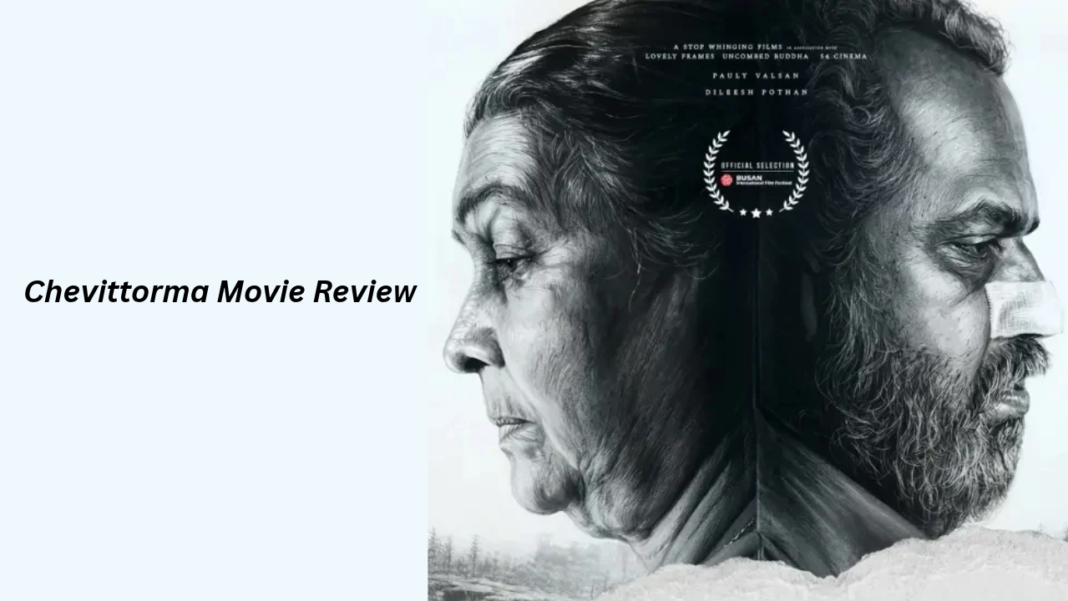

Malayalam cinema continues to delve into the intricacies of human relationships through stories that prioritize performances and storytelling over elaborate technical choices. Chevittorma, aka The Soul Whisperer, is one such drama that takes a casual approach of exploring family wounds, pride, guilt, and the arduous journey to forgive. With Dileesh Pothan and Pauly Valsan in lead roles, the film is directed by Leo Thaddeus.
The film centers on a dying man and his unfinished heart ties, rather than a typical commercial potboiler. Out on the deathbed, you begin to unearth resentments buried long ago, transgressions now forgotten; family dynamics that are more complex than one would like them to be.
Below is our detailed review of Chevittorma, which includes story, cast performance, direction, cinematography, etc., along with pros and cons.
Chevittorma Movie Details
| Category | Details |
| Movie Name | Chevittorma |
| English Title | The Soul Whisperer |
| Language | Malayalam |
| Genre | Drama, Family Drama |
| Director | Leo Thaddeus |
| Lead Actor | Dileesh Pothan |
| Lead Actress | Pauly Valsan |
| Other Key Cast | George Kora, Kabeer |
| Cinematography | Swaroop Sobha Sankar |
| Editing | Carlo Francisco Manatad |
| Main Themes | Family Conflict, Guilt, Forgiveness |
| International Festival | 31st Busan International Film Festival |
| Indian Express Rating | 3.5/5 |
Chevittorma Story: What Is the Movie About?
The story is set in a hilly part of Kerala and follows Varkey from Muthuchira, a powerful landlord whose health is failing, being called to his ancestral home by Theresia, a woman who whispers prayers over passersby nearing death’s door.
Varkey is more than just a dying man. Complications arise, however, due to his relatively fraught relationships, unyielding disposition, and a refusal to confront the past in his final hours. He is starting to physically deteriorate yet will not admit any mistakes or ask anyone for forgiveness for any of the harm he has caused.
Family members arrive to bring forgotten fights back to the fore. Resentful of their rocky bond, George is also less than proud of his own missed opportunities, while Varkey grapples with the pressure and pain inflicted by shattered dreams. Instead of a deserved moment for healing, we are left facing up to decades of cause and effect.
Theresia tries to steer Varkey away towards peace, but the journey brings her own personal trauma and emotions into play. Which means it is a lot more of a family drama: Can people really change when they are finally faced with doing so?
Chevittorma Review: Story and Screenplay
The central idea is the strongest element of Chevittorma. Deathbed is typically defined by farewell, acceptance, and reconciliation. Here, however, it turns into a backdrop for unfinished debates and emotional accounting.
It shows how years of resentment, controlling behaviour and unburdened suffering shape family ties. Instead of making the battle a basic one-and-done as to what is misbehaving—it is so smart in how patterns of damage can be milled from kid to parent to grandkid.
Its storytelling is deliberately restrained. Instead of relying on dramatic twists, much of this film adds emphasis to expressions, moments of silence, and the emotional gravitas of conversation. This technique works for its subject matter, but I can see the pace being a little slow for viewers who enjoy lightning-fast stories.
The discomfort of these questions makes for much of the emotional heft of the film. Can you forgive someone who never takes responsibility? When someone is dying, should they be immediately granted forgiveness? They provide the story with richness that extends beyond its primary family conflict.
Dileesh Pothan’s Performance as Varkey
One of the main positive aspects of the film was Dileesh Pothan. Playing Varkey calls on him to express complex feelings while embodying a man impaired physically by illness and largely restrained in his movements.
He uses understated expressions, breathing patterns, pauses, and reserved responses to expose the character. Through these little nuances, we get to see Varkey’s stubbornness, pride, vulnerabilities, and refusal to accept mistakes over time.
In fact, the performance walks you right up to not making the character wholly sympathetic and stops just short of outright villainy. Rather, it invites the audience to stare at contradictions within a man who has wielded power for most of his life but refuses to deal with the consequences.
As far as the film itself is concerned, Pothan’s very controlled performance is a major plus point, says The Indian Express review. His work shows how a character can occupy the screen without needing extravagant dialogue or action.
Pauly Valsan’s Performance as Theresia
Theresia, here played by Pauly Valsan, first seems like a guide to help dying people feel peace. Her character does evolve, however, becoming an integral part of the film’s emotional journey as we go on.
Theresia does not only observe the family strife. Personal experiences mold her perspective of forgiveness, suffering, and the obligations involved in helping others prepare for death.
Valsan tempers compassion with personal intricacy, endowing the character with an existence beyond her conventionally earnest provision to Varkey as he approaches his final days. Her performance acts as a balance to Pothan’s muted naturalistic approach and offers an additional lens through which the film explores its core ideas.
Direction and Cinematography
Director Leo Thaddeus takes an atmospheric, character-driven approach perfect for the plot. A great deal of the tension plays out in conversations and between people inhabiting a shared space.
Cinematographer Swaroop Sobha Sankar makes use of lighting, shadows, and the environment to underline the film’s sober mood. The visuals add to the sense of alienation, almost emotional stasis that surrounds Varkey and his family.
The film ciya also has a measured pace, which is helped by editor Carlo Francisco Manatad. Minimally, the pauses and the long shots make room for moments to actually linger instead of rushing right towards the next moment of dramatic development.
The technical presentation is most effective when it backs up the internal conflicts of the characters. These choices work to create intimacy rather than madness in a story centered around death, regret, and forgiveness.
What Works and What Doesn’t in Chevittorma?
| Positives | Limitations |
| Dileesh Pothan’s restrained performance | Deliberately slow pacing |
| Pauly Valsan’s emotional portrayal | Limited appeal for action-oriented viewers |
| Thought-provoking family drama | Heavy subject matter throughout |
| Atmospheric cinematography | Requires patience from the audience |
| Strong exploration of generational trauma | Relies heavily on dialogue and character interactions |
| Meaningful themes of guilt and forgiveness | May feel emotionally demanding for some viewers |
Also Read: Raanjhan Lyrics | Ramayana Movie Release Date | Jo Tum Mere Ho Lyrics
Chevittorma Movie Rating and Critical Response
Chevittorma received a rating of 3.5/5 from The Indian Express, which praised its performances, atmospheric execution, and theme of intergenerational trauma. CinemaTalk also has a positive review, singling out the performances and emotional storytelling.
The reviews seem to suggest that the best thing about the film is how interesting the performances and subtext are, but not necessarily its more conventional dramatic appeal.
| Review Source | Rating or Assessment |
| The Indian Express | 3.5/5 |
| CinemaTalk | Positive review; discusses a 3.5/5 rating |
| Overall Critical Impression | A restrained, atmospheric family drama |
Is Chevittorma Worth Watching?
If you are a fan of serious dramas exploring human behaviour and complicated family dynamics, Chevittorma is worth checking out. Dileesh Pothan performs an interesting centre, with Pauly Valsan giving a more localised emotional depth to the story.
The direction is measured, and the cinematography, which creates an atmosphere of dread, devilishly assists the subject matter. That said, its leisurely pace and heavy subtext will likely turn off viewers looking for something a bit less heavy.
Instead of providing a typical narrative involving reconciliation, the film explores breaking down memories. The movie’s most impressive quality is the questions that it causes viewers to reflect on when the credits roll.
Final Verdict
Chevittorma (The Soul Whisperer): A Malayalam film that gives us a sober take on pride, familial cism, guilt, and the possibility of forgiveness. Leo Thaddeus masterfully constructs a personal tale of a dying landlord and the tenants who cannot avoid their own complexities with him.
If there is even minimal merit for the film, it is mainly due to the finely-tuned performances delivered by both director Dileesh Pothan and Pauly Valsan (who goes backstage yet again with a strong performance), combined with German Kwig’s tight cinematography and Mohan Rajen’s subdued editing. The film may be slow for some people, but there is a lot of meaning in the experience through the story rather than explosions.
Frequently Asked Questions
1. What is Chevittorma about?
The film follows a dying landlord whose final days bring unresolved family conflicts, guilt, and questions about forgiveness to the surface.
2. Who directed Chevittorma?
Leo Thaddeus directed the Malayalam drama.
3. Who plays the lead role in Chevittorma?
Dileesh Pothan plays Varkey, with Pauly Valsan appearing as Theresia.
4. What is the English title of Chevittorma?
The film is also known as The Soul Whisperer.
5. What is the rating of Chevittorma?
The Indian Express awarded the film 3.5 out of 5 stars.
6. Is Chevittorma worth watching?
Yes, it is worth considering for viewers who enjoy atmospheric dramas, nuanced performances, and stories exploring family relationships and generational trauma.
Also Read: Aayi Nai Lyrics | Drishyam 3 Box Office Collection | Rakesh Bedi Biography